FMLA vs CFRA: Key Differences
Federal FMLA and California CFRA overlap significantly but have important differences. CFRA is generally more protective for California workers.
| Feature | Federal FMLA | California CFRA |
|---|---|---|
| Employer size | 50+ employees within 75 miles | 5+ employees |
| Employee eligibility | 12 months employed, 1,250 hrs/year | 12 months employed, 1,250 hrs/year |
| Max leave duration | 12 weeks per year | 12 weeks per year |
| Paid? | No (unpaid) | No (unpaid) |
| Covers new child bonding | Yes | Yes |
| Covers siblings | No | Yes (AB 1041) |
| Covers grandparents | No | Yes |
| Covers designated person | No | Yes (AB 1041) |
| Covers pregnancy disability | Yes | No (use PDL instead) |
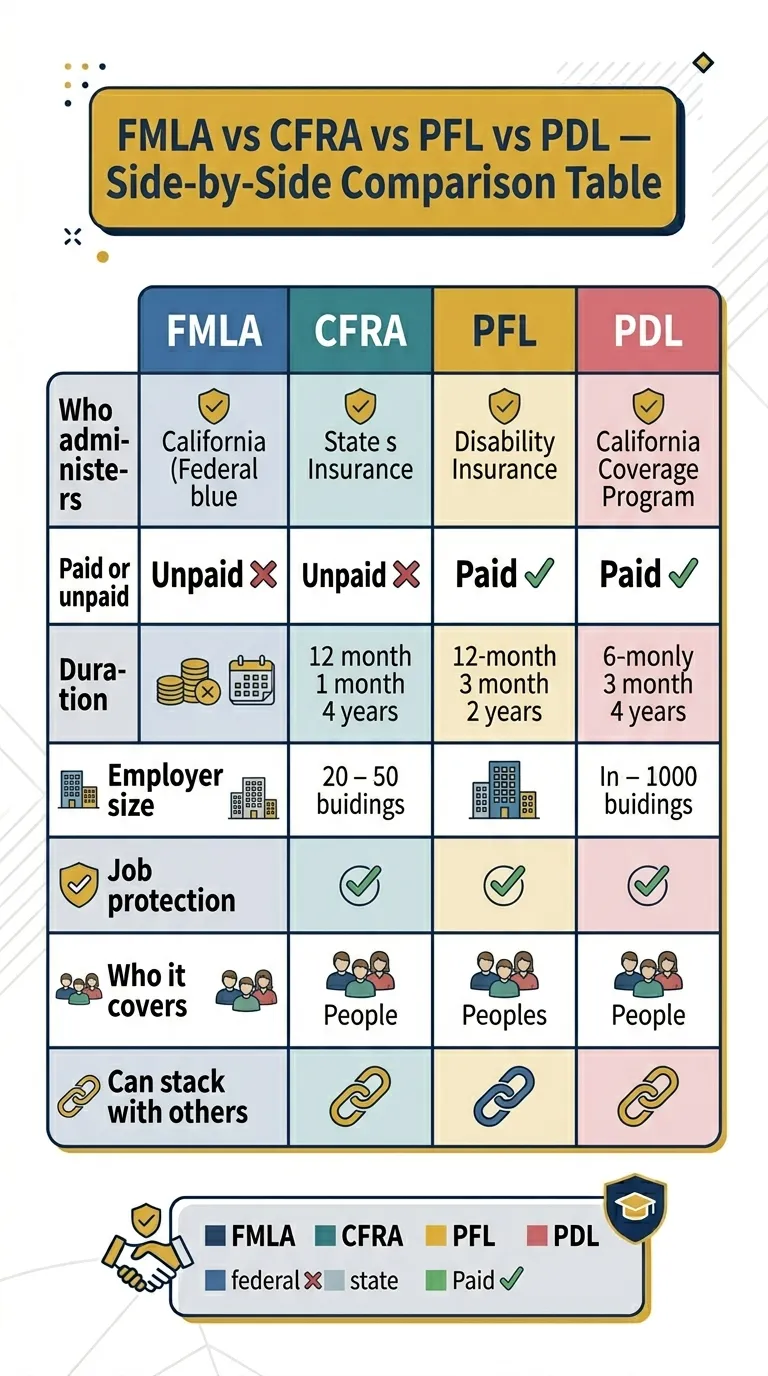
All four California leave programs compared at a glance
How FMLA/CFRA Works with PFL
FMLA and CFRA provide job protection. California PFL provides wage replacement. They run concurrently — you collect PFL money while your job is protected by FMLA/CFRA.
Your employer must hold your position (or equivalent) for up to 12 weeks while you're on qualifying leave.
EDD pays 70–90% of your wages (up to $1,765/week) for up to 8 weeks while you're on CFRA leave.
After PFL ends (8 weeks), CFRA still protects your job for the remaining 4 weeks — but without income replacement unless your employer tops up.
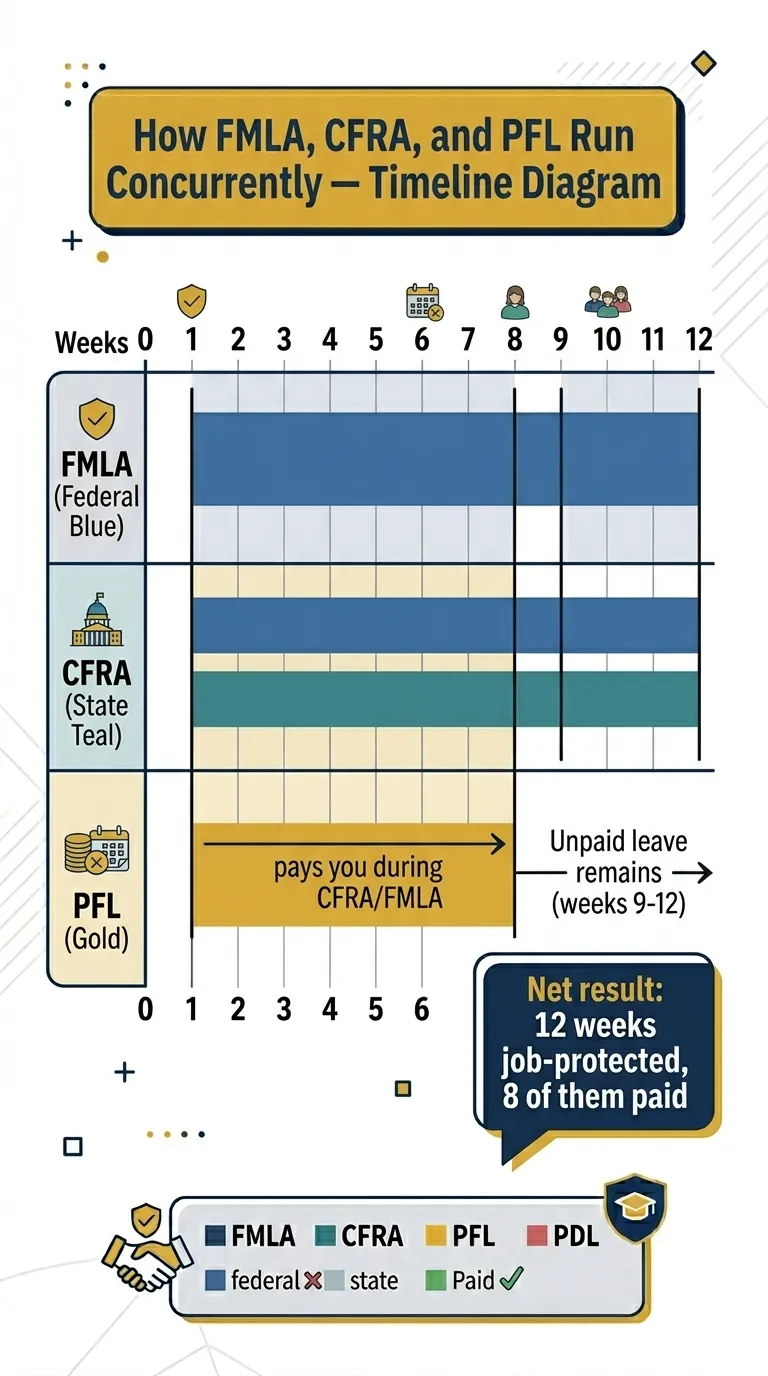
Net result: 12 weeks job-protected, 8 of them paid via PFL
Who Qualifies for CFRA?
- Work for an employer with 5 or more employees
- Have worked for the employer for at least 12 months
- Have worked at least 1,250 hours in the past 12 months
- Need leave to bond with a new child, care for a seriously ill family member, or for your own serious health condition
Qualifying Reasons for CFRA Leave
Birth, adoption, or foster care placement within the first year. Both parents can take CFRA leave.
Spouse, domestic partner, child, parent, parent-in-law, grandparent, grandchild, sibling, or designated person.
CFRA covers your own illness that makes you unable to perform your job. Note: pregnancy disability is covered by PDL, not CFRA.
Qualifying exigency related to a family member's active military duty.
If Your Employer Violates Your FMLA/CFRA Rights
If your employer denies your leave, retaliates, or interferes with your FMLA/CFRA rights: